
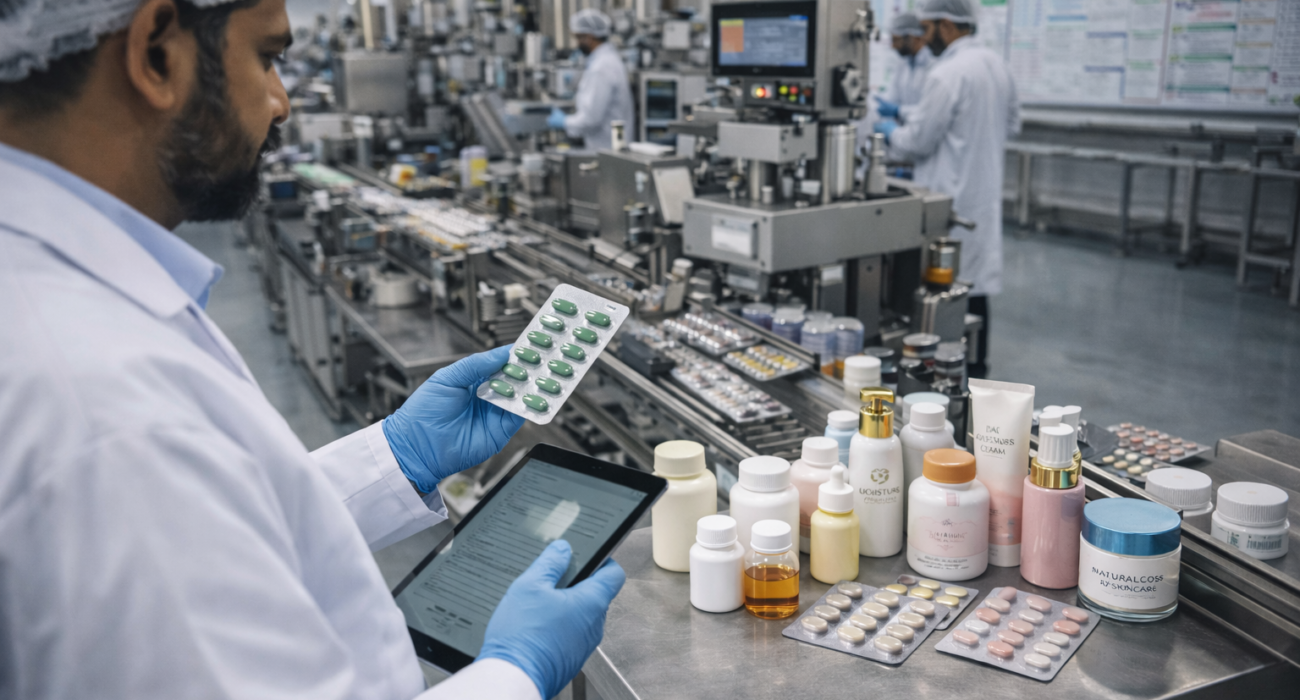
Pharmaceutical Contract Manufacturer in India: What Serious Brands Should Look at Before Finalising One
If you’re searching for a pharmaceutical contract manufacturer in India, you’re already beyond the basic research stage.
You’re not trying to understand what contract manufacturing is.
You’re trying to answer questions like:
-
Which manufacturer will not create problems after launch?
-
Who actually follows compliance, not just claims it?
-
Can they maintain quality when volumes grow?
-
Will they support long-term business or only first few batches?
Most content online explains pharma manufacturing like a brochure or classroom note.
Real pharma manufacturing decisions don’t work that way.
This blog is written for startup pharma owners, distributors, exporters, and brand builders who want clarity before committing capital and reputation.
Pharmaceutical Contract Manufacturer in India is a partnership, not a transaction
Many people treat contract manufacturing as a one-time job:
“I’ll get my product made and move on.”
That approach fails in pharma.
In reality, a pharmaceutical contract manufacturer becomes part of your business backbone.
If they fail, your brand feels it immediately — through complaints, shortages, or regulatory trouble.
That’s why choosing the right partner matters more than choosing the cheapest one.
How pharmaceutical contract manufacturing in India actually starts in India
A reliable contract manufacturer never starts with pricing.
The process starts with understanding:
-
Which products you want to manufacture
-
Dosage forms (tablets, capsules, syrups, ointments, injections, etc.)
-
Domestic market or export focus
-
Expected monthly and quarterly volumes
-
Long-term plan (few SKUs vs full portfolio)
This clarity decides:
-
Production planning
-
Raw material strategy
-
Compliance workload
-
Scalability potential
If a manufacturer jumps straight to a rate card, that’s usually a warning sign.
Product finalisation and documentation come before machines
Once requirements are clear, product finalisation begins.
This includes:
-
Composition and strengths
-
Pack size and packing material
-
Market-specific requirements
-
Stability and regulatory considerations
In pharmaceutical contract manufacturing, documentation is as important as production.
A serious manufacturer prepares and maintains:
-
Master formula records
-
Batch manufacturing records
-
Standard operating procedures
-
Quality and stability documentation
Weak documentation doesn’t cause issues immediately — it causes issues during audits, expansion, or exports.
Raw material sourcing is where quality actually starts
Many brands assume quality starts on the production line.
It doesn’t.
Quality starts with raw materials.
Strong pharmaceutical contract manufacturers:
-
Work only with approved vendors
-
Test incoming materials
-
Maintain traceability
-
Avoid emergency or last-minute sourcing
Compromising here leads to:
-
Batch inconsistency
-
Stability failures
-
Regulatory risk
This is one area where experienced manufacturers are very strict — and rightly so.
pharmaceutical contract manufacturing in India is about control, not speed
In pharma, faster is not better.
During production:
-
Equipment calibration matters
-
Environmental conditions matter
-
Process sequence matters
-
Deviations must be recorded and handled properly
Whether it’s tablets, capsules, or liquids, process discipline is what ensures repeatable quality.
Manufacturers who rush batches to meet timelines usually create bigger problems later.
Quality control is not optional — it’s the backbone
Every manufacturer claims to have QC.
The difference lies in how QC is practiced.
A dependable pharmaceutical contract manufacturer follows:
-
Raw material testing
-
In-process quality checks
-
Finished product testing
-
Retention samples
-
Batch release approvals
If QC is treated as a formality, problems show up after products reach the market — when fixing them is costly.
Compliance is where weak manufacturers eventually get exposed
Pharma manufacturing in India is strictly regulated.
A compliant manufacturer maintains:
-
Valid drug manufacturing licenses
-
GMP-aligned practices
-
Updated documentation
-
Audit readiness
As a brand owner, you don’t need your own manufacturing license if you work with a licensed unit.
But you are fully responsible for choosing a compliant partner.
Compliance shortcuts don’t show on day one — they show during inspections, distributor audits, or export expansion.
Packaging, labelling, and traceability are critical stages
Once products clear QC, packaging begins.
This includes:
-
Correct packing materials
-
Batch coding
-
Manufacturing and expiry dates
-
Proper storage and dispatch readiness
Packaging errors in pharma are serious.
They can lead to recalls, distributor rejection, or regulatory notices.
That’s why experienced contract manufacturers treat this stage very carefully.
Scalability: the real test of a pharmaceutical contract manufacturer
Many manufacturers can handle:
-
Trial batches
-
Low initial volumes
Problems start when:
-
Orders increase
-
Distribution expands
-
Export enquiries come in
Real scalability requires:
-
Capacity planning
-
Stable raw material sourcing
-
Manpower readiness
-
Process repeatability
Before finalising a manufacturer, always ask:
“What happens when my volume doubles?”
If the answer is unclear, scalability is weak.
Why India is strong for pharmaceutical contract manufacturing
India has become a global hub because of:
-
Skilled technical manpower
-
Strong regulatory framework
-
Cost-effective production
-
Experience with domestic and export markets
But this strength only benefits you if the individual manufacturing unit follows systems properly.
Country advantage cannot compensate for poor internal processes.
How Impelled Remedies approaches contract manufacturing
Impelled Remedies works with the belief that brands grow only when manufacturing stays stable.
The approach focuses on:
-
Clear process communication from day one
-
Compliance-first operations
-
Strong quality control discipline
-
Scalable production planning
-
Transparent coordination with brand owners
Instead of focusing on short-term orders, the emphasis stays on long-term manufacturing partnerships.
This approach suits:
-
New pharma brands
-
Distributors expanding portfolios
-
Export-focused companies
-
Businesses planning sustainable growth
What you should evaluate before finalising any contract manufacturer
Instead of comparing only prices, evaluate:
-
Process clarity
-
QC systems
-
Compliance history
-
Scalability readiness
-
Communication transparency
A slightly higher cost with a stable manufacturer is always safer than cheap batches with future damage.
Frequently Asked Questions
Is pharmaceutical contract manufacturing legal in India?
Yes, when done through a licensed and compliant manufacturer.
Do I need my own drug manufacturing license?
No. The manufacturer holds the license.
How long does contract manufacturing usually take?
Typically 30–60 days depending on product and volume.
Can I start with low quantities?
Yes, but scalability should be planned from the beginning.
Is export possible through contract manufacturing?
Yes, subject to regulatory and market requirements.
Final Thought
If you’re looking for a pharmaceutical contract manufacturer in India, what you’re really choosing is a long-term partner for your brand.
Price matters.
But process, compliance, quality control, and scalability matter more.
👉 Talk to Our Manufacturing Expert
or
👉 Request Manufacturing Quote
A clear discussion now prevents expensive problems later.