
Pharmaceutical Production in India – What the Pharma Manufacturing Industry Really Demands From Growing Brands
When someone searches pharmaceutical production, they’re rarely looking for a textbook definition. They are trying to understand how real pharma production works on the ground in India. They want clarity on how medicines are actually produced at scale, how consistency is maintained across batches, how regulatory requirements fit into daily operations, and how to choose the right manufacturing partner without risking brand credibility.
India’s pharmaceutical manufacturing industry is one of the largest in the world. It supplies domestic markets, institutional tenders, and exports to regulated countries. But despite its size, the industry is not uniform. Some manufacturers operate with strong systems, documented processes, and strict compliance. Others operate reactively, solving issues only after they arise. The difference between these two approaches becomes visible when demand increases, when audits occur, or when product complaints surface in the market.
Understanding pharmaceutical production properly is not optional for startup founders, brand owners, distributors, or exporters. It is foundational to long-term growth.
Pharmaceutical Production Is a Structured System, Not Just a Manufacturing Activity
Pharma production is often misunderstood as simply “making tablets or syrups.” In reality, pharmaceutical production is a controlled system made up of interlinked processes. It begins with sourcing and continues through formulation, processing, packaging, testing, and documentation.
A serious pharmaceutical production setup includes:
-
Vendor qualification for raw materials
-
Controlled storage conditions
-
Environmental monitoring
-
Process parameter validation
-
In-process quality checks
-
Finished product testing
-
Stability studies
-
Batch record documentation
-
Traceability systems
If any one of these layers weakens, the entire production chain becomes vulnerable. In the pharmaceutical manufacturing industry, repeatability is more important than speed. Producing one successful batch means little if the next one behaves differently.
Planning – The Foundation of Scalable Pharma Production
Before machines run, planning defines the structure of pharma production. Manufacturers must evaluate dosage forms, volume expectations, packaging configurations, distribution models, and growth projections. Production planning is not about filling today’s orders only; it is about preparing for future expansion.
For example, a brand launching five SKUs today may expand to twenty within a year. If the pharmaceutical production system is not designed for expansion, scaling becomes chaotic. Raw material shortages occur, machine scheduling conflicts arise, QC teams become overloaded, and delivery timelines slip.
Structured pharmaceutical manufacturing industry players integrate planning into daily operations. They forecast material requirements, maintain buffer stocks where necessary, and align manpower capacity with expected production volumes. This forward planning creates predictability.
Raw Material Discipline – Where Most Production Risks Begin
In the pharmaceutical manufacturing industry, raw material control is critical. APIs and excipients must be sourced from qualified vendors, tested before release, and stored under appropriate conditions. A slight variation in API potency or impurity profile can affect finished product stability and efficacy.
Reliable pharma production systems implement:
-
Approved vendor lists
-
Incoming material testing
-
Quarantine storage until clearance
-
Batch traceability
-
Environmental control in warehouses
Switching suppliers casually for cost reasons can introduce variability. Once a compromised batch enters production, problems multiply downstream. Market complaints, regulatory scrutiny, and brand damage follow.
Disciplined raw material management protects long-term production integrity.
Process Control – Turning Manufacturing Into Industrial Production
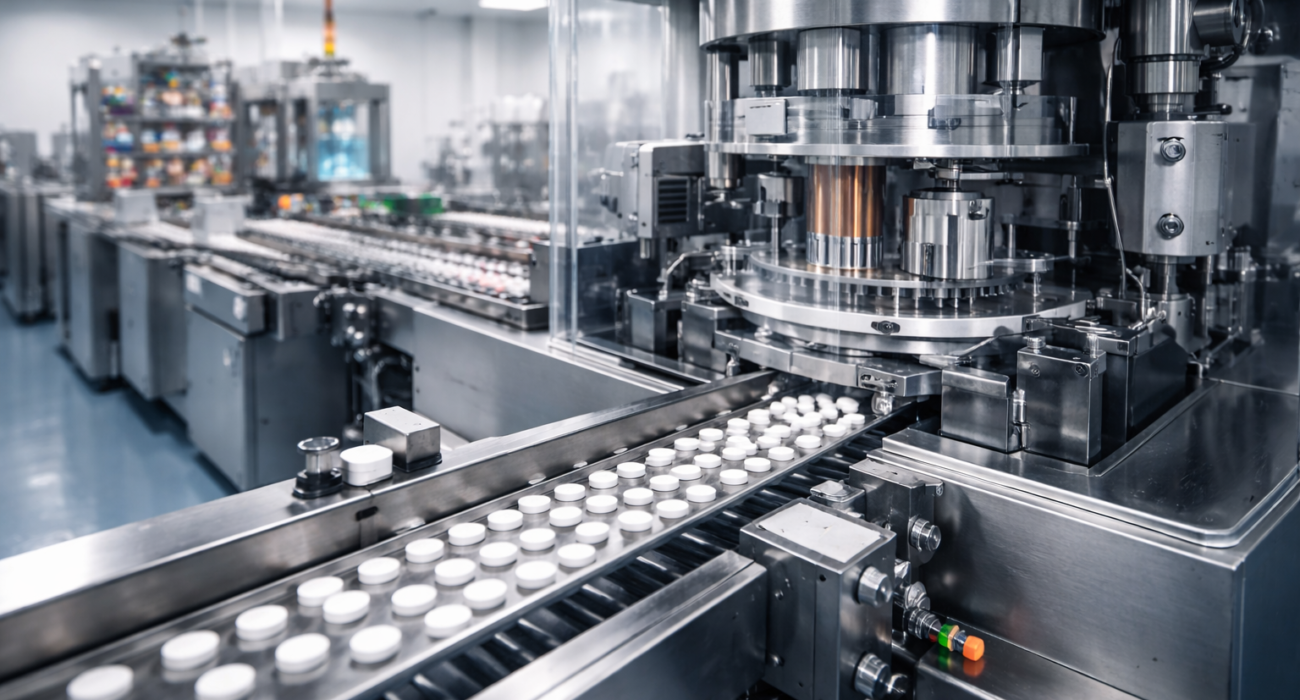
The heart of pharmaceutical production lies in process control. Tablet manufacturing requires controlled granulation moisture, consistent compression force, monitored hardness, and uniform coating thickness. Even small deviations affect dissolution profiles and therapeutic performance.
Capsule production demands accurate fill weights and shell integrity. Liquid formulations require precise mixing sequences, temperature stability, preservative balance, and microbial control.
In a strong pharma production system, these parameters are not adjusted casually. They are validated, documented, and monitored continuously. Deviations are recorded and investigated. Corrective actions are implemented systematically.
This level of discipline distinguishes structured pharmaceutical production from inconsistent manufacturing.
Quality Control – Integrated, Not Isolated
Quality control is not a final checkpoint at the end of production. It is integrated throughout the process. In-process testing ensures uniformity during manufacturing. Finished product testing confirms compliance with specifications. Stability testing verifies long-term shelf life.
The pharmaceutical manufacturing industry depends on detailed documentation:
-
Batch manufacturing records
-
Analytical reports
-
Stability data
-
Deviation logs
-
Retention samples
As production scales, QC systems must expand proportionally. Without scaling QC capacity, product risk increases. Complaints that seem isolated at low volume become frequent at higher output levels.
Reliable pharma production treats quality control as a parallel system, not an afterthought.
Compliance – The Non-Negotiable Framework
The Indian pharmaceutical manufacturing industry operates under regulatory oversight. GMP compliance, valid drug licenses, audit readiness, and structured documentation are mandatory. Compliance protects not just exports but domestic distribution as well.
Regulatory inspections evaluate documentation, process validation, environmental controls, and quality management systems. Manufacturers with weak compliance face operational disruption.
For growing brands, choosing a manufacturing partner with disciplined compliance systems reduces long-term risk. Compliance ensures continuity.
Scalability – The True Test of Pharmaceutical Production Strength
Small batch manufacturing can appear stable. Scalability tests the system. Can the facility handle increased output without cutting corners? Can raw materials be secured during demand spikes? Can QC maintain turnaround times? Can documentation remain structured under pressure?
Scaling exposes weak systems quickly. Delivery delays increase. Communication becomes reactive. Quality variations emerge.
Strong pharmaceutical production systems are designed with scalability in mind. Machinery capacity, workforce allocation, and material procurement strategies are aligned with growth projections.
Scalability is not improvised. It is engineered.
Why Many Brands Reevaluate Their Production Strategy
Startups often begin with smaller manufacturers because initial orders are manageable. However, as demand grows, production stress appears. Inconsistent supply, delayed dispatches, and limited documentation create friction.
At this stage, brand owners realize pharmaceutical production stability is more valuable than minimal cost savings. Structured pharma production supports expansion into new regions and institutional segments.
The pharmaceutical manufacturing industry rewards disciplined systems. Brands that align with such systems experience smoother growth.
Third-Party Manufacturing Within the Pharma Manufacturing Industry
Owning manufacturing infrastructure is not mandatory to build a successful pharma brand. India’s pharmaceutical manufacturing industry supports structured third-party production models.
The key lies in selecting a partner with validated processes, integrated QC, compliance discipline, and scalable infrastructure. Third-party pharma production works effectively when systems are industrial-level rather than informal.
Impelled Remedies and Structured Pharma Production
Impelled Remedies operates from Ambala, Haryana, focusing on structured third-party and contract pharmaceutical production. The emphasis is on controlled process systems, strong QC integration, compliance-first operations, and practical scalability planning.
For founders, distributors, and exporters seeking production stability, structured manufacturing partnerships reduce operational stress and improve predictability.
Evaluating a Pharmaceutical Production Partner
When selecting a manufacturing partner, consider:
-
Vendor qualification systems
-
Process validation documentation
-
QC capacity
-
Regulatory compliance history
-
Production scalability planning
-
Communication transparency
Reliable pharma production is built on structured discipline, not short-term adjustments.
FAQs
Is pharmaceutical production the same as pharma production?
The terms are commonly used interchangeably, referring to the operational systems within the broader pharmaceutical manufacturing industry.
Can third-party manufacturing handle industrial-scale production?
Yes, provided infrastructure, quality systems, and compliance frameworks are robust.
Does scaling increase quality risk?
Scaling increases complexity. Risk rises only when systems fail to expand alongside output.
Why is documentation so important in pharma production?
Documentation ensures traceability, regulatory compliance, and operational accountability.
How can startups ensure long-term production stability?
By partnering with manufacturers that prioritize process control, QC integration, compliance, and scalability planning.
If you are planning pharmaceutical production in India and want a structured, compliant, and scalable manufacturing partner:
👉 Talk to Our Manufacturing Expert
👉 Request Manufacturing Quote
Let’s align your product strategy with disciplined pharma production systems built for growth.